
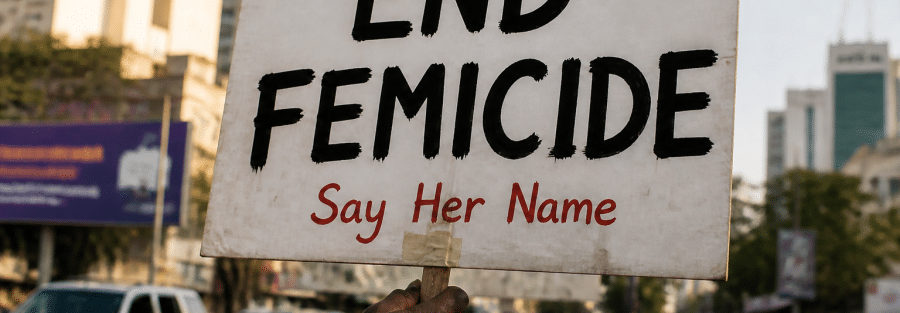
In a femicide case in April 2026, Anita Mugweru was killed by her husband, a Kenya Defense Forces soldier, in front of their young child. Around the same time, in Migori, Davine Kwamboka’s final moments were captured on a CCTV camera. In Mombasa, Susan Achieng Mitoh was dead by April 14. Three women. Three counties. Three weeks.
These are not isolated tragedies. They are dispatches from a country that has decided it can live with this.
Kenya has documented at least 220 femicide cases in 2025 alone—roughly eight killings per week, according to Amnesty Kenya’s media monitoring. We are five months into 2026, and the pace has not slowed.
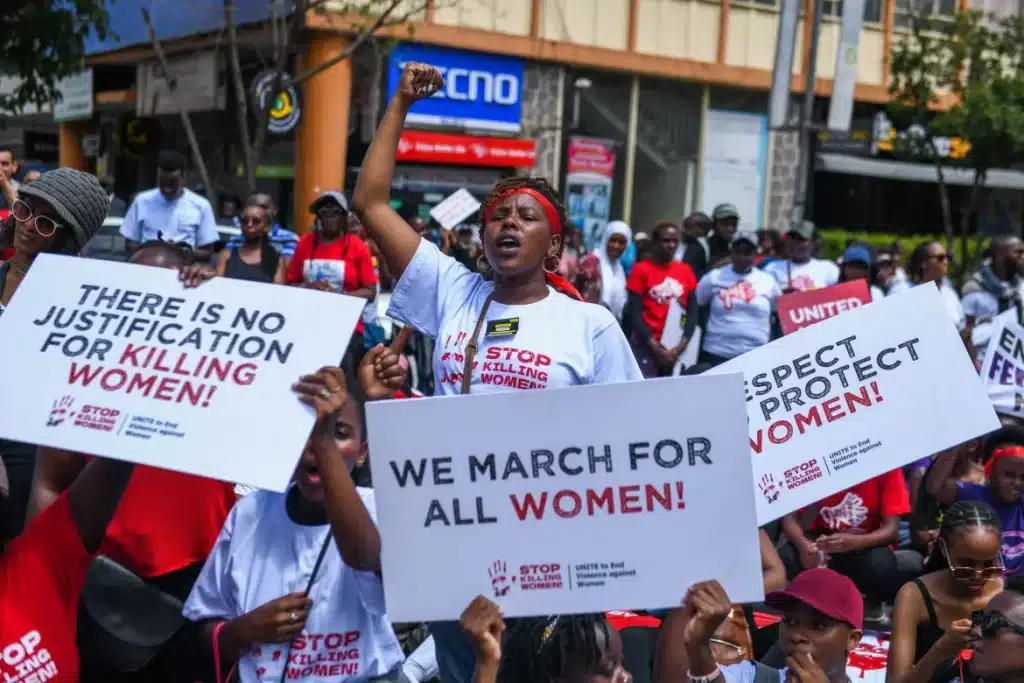
The killing of women by people who claim to love them has a name: femicide. It is not a relationship dispute. It is not a crime of passion. It is the most extreme end of a continuum of gender-based violence—one that begins with control, escalates through abuse, and ends, too often, in death. When we call it anything else, we protect the system that produces it.
The Femicide Crisis in Kenya: A Report That Changed Nothing
In November 2025, President Ruto received the Report of the Technical Working Group on Gender-Based Violence Including Femicide—a government-commissioned body chaired by former Deputy Chief Justice Dr. Nancy Baraza, convened specifically in response to the public outcry over the femicide crisis. The Working Group spent months conducting nationwide consultations with survivors, service providers, law enforcement, and communities. Their mandate was to assess the scale of the problem, identify the failures in the system, and recommend concrete action. It was serious work. It clearly named the problem and gave the government a roadmap: enact a standalone femicide law, strengthen protection mechanisms, fix data systems, and hold institutions accountable. That was six months ago.
It has been met with silence.
No legislation has been tabled to recognize femicide as a distinct crime under Kenyan law. No timeline has been announced. No accountability mechanism has been activated. The report sits, formally received, functionally ignored, while the death toll continues to climb. It falls to civil society organizations, journalists, and ordinary citizens to refuse to let that silence stand. Pressure is not optional. It is the mechanism.
This is not a capacity problem. It is a political choice.
How the Femicide Crisis in Kenya Turns Homes Into Danger Zones
Over 70 percent of femicide cases in Kenya occur within the home. The perpetrator is, in the overwhelming majority of cases, someone the victim knew, trusted, or depended on. This is not a stranger-danger crisis. It is a crisis of intimate violence.
FIDA-Kenya has raised alarm over killings reported across at least ten counties in early 2026: Kisumu, Kirinyaga, Machakos, Trans Nzoia, Uasin Gishu, Nakuru, Kiambu, Laikipia, Nyeri, and Mombasa. The TWG report identifies hotspots not as statistical curiosities but as evidence of systemic failure – places where reporting systems are weak, where protection orders are unenforced, where survivors cannot access justice.
Femicide is not evenly distributed because bad luck is not evenly distributed. It concentrates where impunity concentrates.
What silence costs
The TWG report is explicit: Kenya lacks a standalone femicide law. Cases are prosecuted under general homicide provisions, which erase the gendered nature of the crime, suppress data collection, and make pattern recognition nearly impossible. Without femicide as a distinct legal category, Kenya cannot count what it refuses to name.
The social cost is equally severe. Children who witness femicide carry that violence with them. Communities that experience it without accountability learn that women’s lives are negotiable. Every unprosecuted case is a lesson in impunity—and impunity is a condition for the next killing.
The government received the roadmap. It has not taken a single step. The question is no longer what needs to be done—it is who will be held responsible for not doing it.
What must happen – and who must make it happen
The TWG report has done the diagnostic work. Civil society has done the advocacy work. The data exists. The recommendations are on the President’s desk. What is missing is political will, and political will responds to pressure.
Parliament must act. Femicide must be legislated as a distinct crime, with specific provisions for investigation, prosecution, and sentencing that reflect the gendered nature of the offense.
The National Police Service must be accountable. Survivors report that GBV complaints are routinely dismissed, minimized, or redirected. Officers must be trained and held to account, including through public reporting on case outcomes.
Data collection must be mandatory and public. KNBS, the NPS, and the DCI must report consistently on femicide cases disaggregated by county, relationship to perpetrator, and case outcome. A crisis you cannot count is a crisis you can deny.
The TWG recommendations must be implemented on a public timeline. Civil society and the public must demand that the government table an implementation plan—with milestones, responsible offices, and consequences for delay.
Femicide does not happen because some men are monsters. It happens because the systems around those men—the courts, the police, the laws, and the social norms—have made it survivable for perpetrators and unsurvivable for women. That is a policy failure. And policy failures have solutions.
The question Kenya must answer is not whether the data is compelling enough, or the report thorough enough, or the cases visible enough. Davine, Anita, and Susan answered that question. The question is whether the people in power will be made to act or allowed to look away again on femicide cases.